Low Prep and Home School Friendly
As I am writing this, it’s nearly the end of the school year. My students are mentally halfway to summer… and if you’re like me, running on fumes while being expected to keep things meaningful and manageable, you’ll want something that is:
Low prep. Highly engaging. Still builds skills.
When I say ‘EASY’, I meant these lessons are very easy to implement. Perfect for busy teachers and parents that are home schooling. But I’ve added the level of difficulty (for students). You can take that into consideration. You can choose depending on how motivated your students are to get something done this time of the year!
These 3 projects are lessons I’ve used that my students enjoyed during this time. You can check which lesson fits your time frame- though most of the lessons can be standalone lessons!
I’ve included 2 FREE downloadable lessons in this post. Check them out below.
Affiliate Disclosure: As an Amazon Associate I earn from qualifying purchases. Some links on this site are affiliate links, which means I may earn a small commission if you make a purchase, at no additional cost to you.
1. Surreal Geometric Creature Art (4 Lessons)
LEVEL OF DIFFICULTY FOR STUDENTS: MEDIUM
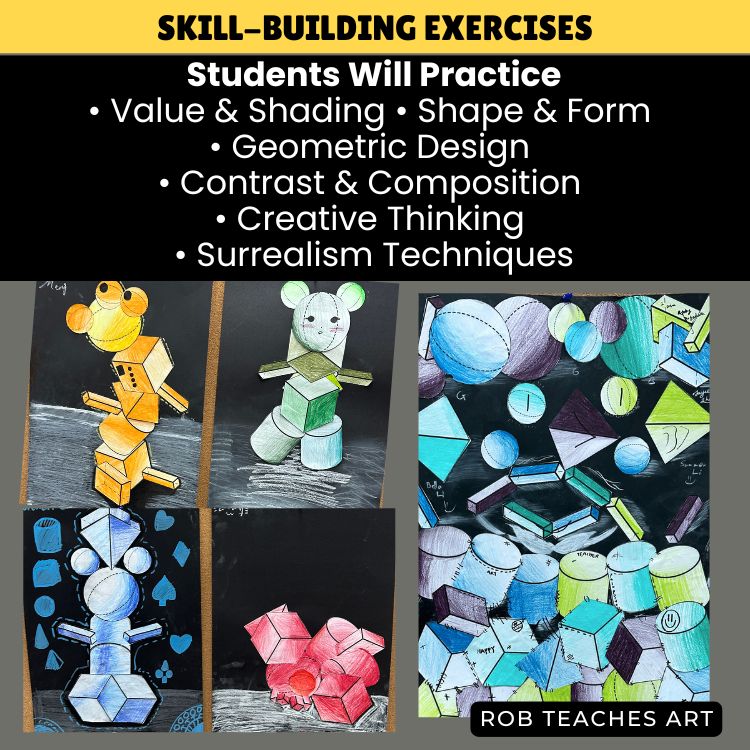
In this lesson, students will transform geometric shapes into surreal creatures while practicing value shading, monochrome and complementary color schemes, and creative composition.
Students begin by practicing value shading from observation, then plan and construct a surreal creature using cut geometric prisms or flat shapes. The final artwork is assembled on A3 black construction paper, creating a bold and visually striking finished piece.
Here is a snapshot of the lesson:
Learning Goals
- Understand form using 3D shapes (prisms)
- Improve value shading
- Develop creative composition
The Task
Students create a surreal creature using geometric forms (cubes, cones, cylinders) and apply shading to make it look 3D.
Materials
- Drawing paper (A3 recommended) – You can print the worksheets on these sheets.
- Staedtler Pencils – Great for beginners and professionals
- Erasers
- Rulers
- Fine liners – These are great for adding fine lines and details.
- Prismacolor’s Colored pencils or markers
Step by Step Plan
Lesson 1: Warm up – Value Match
Students practice shading geometric forms by observing light and shadow on still life references. They experiment with monochrome or complementary color schemes while learning how value creates depth and form.
Lesson 2 — Plan Your Surreal Geometric Creature
Students brainstorm and plan a surreal creature using geometric shapes through sketching or cut-and-arrange composition activities. They explore overlapping, rotation, composition, and creative problem-solving while designing their creature layout.
Lesson 3 — Color & Shade Your Shapes
Students apply color and value shading to their geometric shapes using either monochrome or complementary color schemes. After carefully coloring and shading each form, students cut out and organize their shapes for final assembly.
Lesson 4 — Assemble Your Surreal Geometric Creature
Students assemble their colored shapes into a final surreal creature composition on black construction paper using overlap and layering techniques. They complete the artwork by adding details, personality, and ground shadows to create depth and presentation.
No Time to Prep?
If you don’t want to build this from scratch:
👉 I’ve already made this into a full lesson (with worksheets, scaffolding, and steps ready to go)
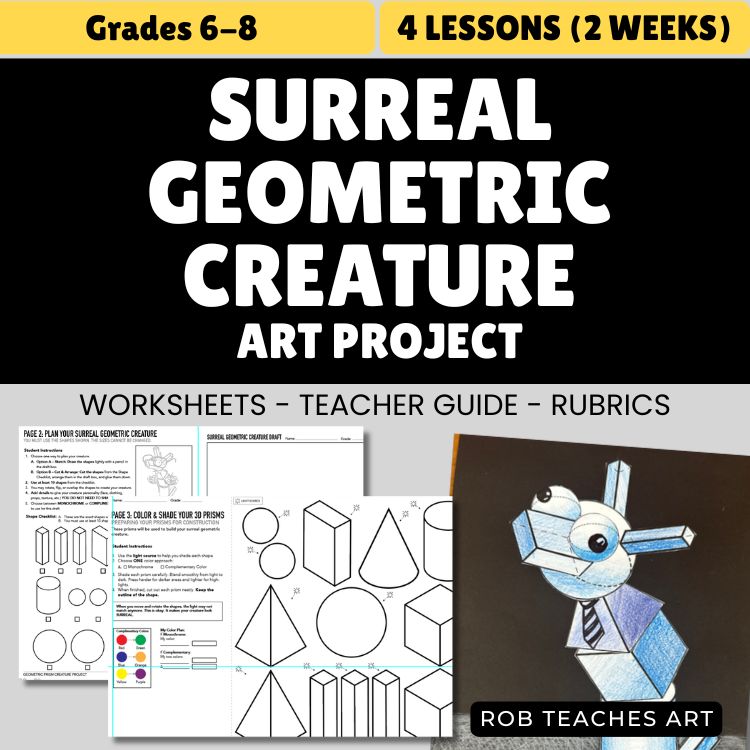
Just print and hand it out.
2. Experimental Line Drawing Activity (45-Minute Lesson)
LEVEL OF DIFFICULTY FOR STUDENTS: VERY EASY
This low-prep line drawing activity encourages students to experiment with expressive mark-making, observation, and creative risk-taking using only simple materials. Students explore how different types of lines can communicate movement, emotion, texture, and personality through a series of fast-paced drawing challenges and observational exercises. The lesson works well as an icebreaker, first-week activity, sub plan, sketchbook exercise, or introduction to the Elements of Art.
You can download the PPT and Lesson Plan for free:
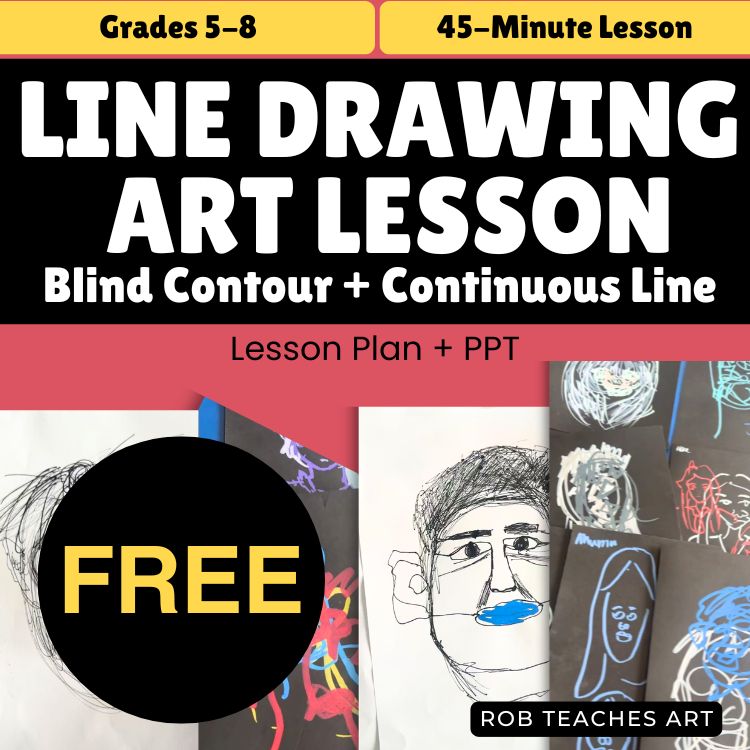
Learning Goals
- Explore different types of lines and mark-making techniques
- Understand how lines can communicate emotion, movement, and texture
- Experiment with observational and imaginative drawing
- Develop creative confidence through low-pressure art challenges
- Practice composition, spacing, and visual organization
- Reflect on how artists use line in different ways
The Task
Students complete a blind contour drawing exercise where they carefully observe an object, their hand, or a classmate while drawing without looking at their paper. The activity encourages slower observation, continuous line movement, and creative imperfections, helping students focus on seeing details rather than trying to create a “perfect” drawing.
Materials
- Paper or sketchbook
- Pencil
- Black pen or marker
- Optional colored markers/pencils
3. Comic Book Character Design, Typography Exercise and One-Point Perspective Cover Project (3 Lessons)
LEVEL OF DIFFICULTY FOR STUDENTS: MEDIUM to HARD
The best thing about this project is that each lesson can be a standalone lesson and can also be used as a sub plan.
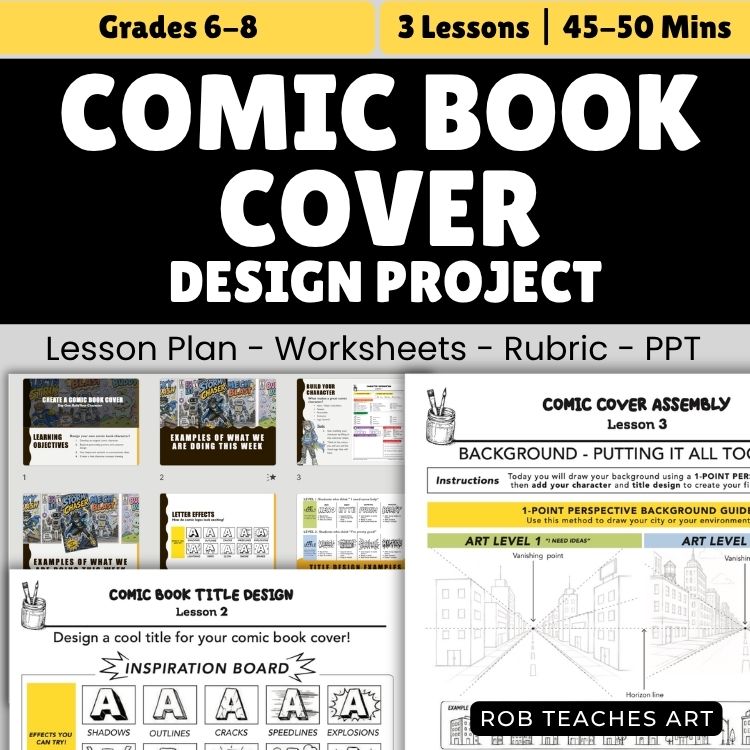
In this project, students will create an original comic book cover through a scaffolded 3-part design process focused on character creation, comic-style typography, and visual storytelling.
Here is a snapshot of the lesson:
Learning Goals
- Design an original comic character
- Create comic-style typography and title designs
- Apply one-point perspective techniques
- Explore layering, overlap, and composition
- Combine visual elements into a final comic book cover
- Use visual storytelling to communicate personality and action
- Reflect on creative choices and craftsmanship
The Task
Students will develop a superhero or villain character, design a bold comic title logo, and assemble a final comic cover using one-point perspective, layering, overlap, and composition techniques to create depth, action, and personality.
Materials
- Paper or sketchbooks
- Pencils and erasers
- Fine liners
- Markers or colored pencils
Step by Step Plan
Lesson 1: Character Design & Visual Identity
Students develop an original superhero or villain character by exploring personality traits, powers, costumes, symbols, and color choices through guided planning activities. Using worksheets and scaffolded examples, students then create a final character concept drawing focused on action, visual identity, and recognizable design rather than realism.
You can download lesson 1 for free here:

Lesson 2: Comic Book Title Design
Students explore comic-style typography by experimenting with lettering effects such as outlines, shadows, cracks, glow effects, and speed lines to create a bold comic logo/title that matches their character’s identity. After sketching multiple ideas and testing visual effects, students complete a final comic book title design that communicates personality, mood, and genre.
Lesson 3: Comic Cover Assembly
Students create a one-point perspective background using a horizon line and vanishing point before combining their character, comic title, and environment into a final layered comic book cover composition. Through cutting, arranging, overlapping, and composition techniques, students learn how foreground, background, and depth work together to create an exciting and visually dynamic final cover.
👉 Get the complete project here:
Looking for more middle school art projects?
Check out the rest of my TPT store for scaffolded lessons, creative projects, worksheets, and low-prep art activities designed for real classrooms.


Leave a comment